

US midterm election politics dominated a turbulent week as Democrats won control of both the House of Representatives and Senate. Wall Street initially welcomed the result: the Dow rose about 3% on Wednesday, while the S&P 500 and Nasdaq each gained 1.5%. That relief quickly gave way to questions about which businesses might gain or lose from the new political balance. Data-centre operators faced concerns about tighter regulation. Importantly, these were market expectations, not newly enacted policies. For investors, the result changed the outlook for regulation and public spending but did not immediately change company earnings. The sharp reversal illustrated how quickly a favourable political outcome can produce quite different reactions across sectors.
Hopes that the election result might encourage a settlement of the US–Iran war helped drive a steep fall in oil prices, but there was no confirmed peace agreement by Friday. Qatar continued mediation efforts, while attacks on shipping around the Gulf and Strait of Hormuz kept supply risks firmly in view. Late on Friday, renewed concern about possible US strikes helped crude recover slightly: Brent settled at $98.32 a barrel and US crude at $90.83. Nevertheless, Reuters reported weekly falls of 17% and 13%, respectively. The investment message was mixed. Cheaper oil could ease pressure on household budgets and business costs, but the continuing threat to shipping meant that markets could not safely assume energy supplies were returning to normal.
Friday’s October employment report offered reassurance that the US economy was still creating jobs. Employers added 165,000 positions, and unemployment stood at 4.1%, which the Bureau of Labor Statistics described as little changed. Professional and business services, healthcare, and transport and warehousing led hiring. However, the report was not uniformly strong: the number working part-time (because they could not obtain enough hours or full-time work) increased to 4.8 million. Markets also faced an awkward consequence of stronger hiring: it reduced the argument for easier monetary policy and reinforced expectations of a possible Federal Reserve rate increase in December. Money markets now put the probability at 90%. In simple terms, a healthier economy supported the earnings outlook, but potentially higher borrowing costs remained a headwind for share prices
Semiconductor shares were at the centre of Thursday’s rout as investors worried that the election outcome could slow data-centre construction and bring tougher oversight of artificial intelligence. The concern was about the pace of future spending, rather than proof that demand for advanced chips had disappeared. Friday brought a partial recovery as the semiconductor index clawed back a third of the amount lost the previous day. The rebound did not, however, show that the uncertainty was over. A balanced interpretation is that investors were reassessing both growth expectations and the prices they were prepared to pay, rather than reaching a settled verdict on AI’s long-term commercial value.
The main domestic UK development was the Bank of England’s decision on Thursday to raise interest rates by a quarter of a percentage point to 4%. Eight policymakers supported that increase; the ninth wanted a larger rise to 4.25%. Inflation had reached 3.5% in September, and the Bank forecast that it could approach 5% by the middle of 2027, largely because of energy costs. That was a forecast, not a current inflation reading. Although evidence of energy costs spreading into other prices and wages remained limited, policymakers judged that the risks warranted action. For investors, the key tension was between controlling inflation and avoiding unnecessary damage to activity. The Bank stressed that further decisions would depend on the evidence, rather than follow an automatic sequence of increases.
London was not insulated from the global retreat. The FTSE 100 closed the week 0.5% lower, whilst the FTSE 250 retained a fractional weekly gain. Selling spread beyond technology-related businesses: telecoms led the declines, energy shares fell, and traditionally defensive sectors also weakened. Precious-metal miners provided an exception, rising 1.7%. Separately, Lloyds reported that house prices fell at their fastest annual pace in a year in October as mortgage costs weighed on demand. Together, these developments left UK investors balancing overseas market turbulence against domestic pressure from financing costs.
This week in the US, the main releases are October consumer price inflation on Tuesday and producer price inflation on Friday. These will help investors assess price pressures and household purchasing power ahead of the Federal Reserve’s next interest-rate decision. In the UK, on Thursday we see the first estimate of third-quarter GDP alongside September’s monthly GDP, industrial production, services and trade figures. Together, these releases will show how broadly economic activity is holding up and provide important context for the Bank of England’s policy outlook.
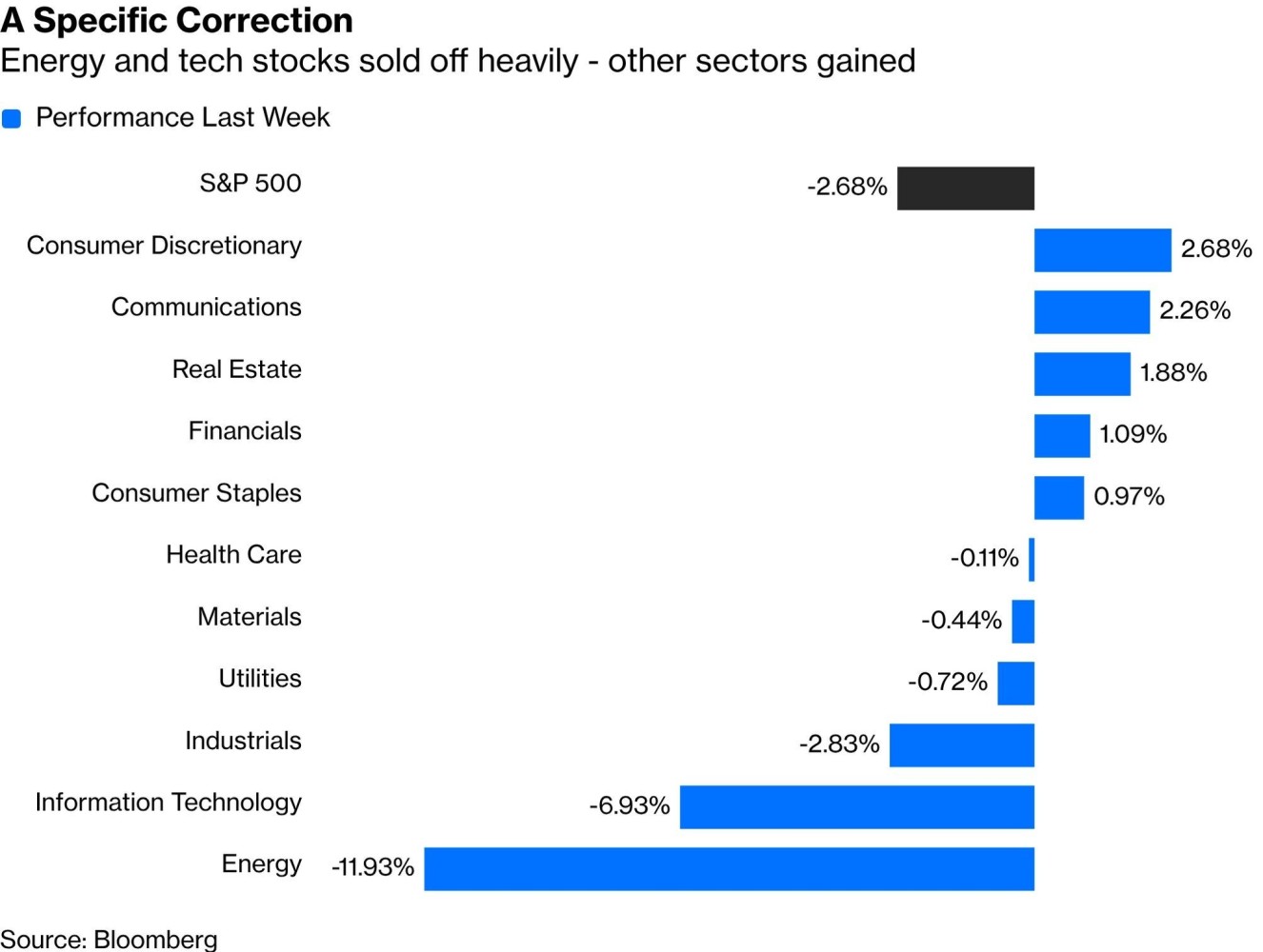
Last week’s 2.68% fall in the S&P 500 was driven by two sectors. Energy fell almost 12% as oil prices tumbled, and information technology fell nearly 7% amid concern over data-centre spending, while five sectors, led by consumer discretionary, finished higher.
Information Powered by TEAM Asset Management & NEBA Financial Solutions
This article first appeared in the NEBA Weekly Update newsletter on LinkedIn.
