This guide has structured products explained in plain English: the main types, how they work in practice, and where they fit in a portfolio. For the bare definition on its own, see our pillar on what is a structured product.
Once upon a time, the retail investment world was a quiet, rather pleasant place where a small, distinguished cadre of trustees and asset managers devised prudent portfolios for their well-heeled clients within a narrowly defined range of high-quality debt and equity instruments. Financial innovation and the rise of the investor class changed all that.
One innovation that has gained traction as a supplement to traditional retail and institutional portfolios is the investment class broadly known as Structured Products. Structured products offer retail investors easy access to derivatives.
In this article, we will provide you with an introduction to structured products, with a particular focus on their applicability in diversified retail portfolios.
What Are Structured Products?
Structured products are designed to facilitate highly customized risk-return objectives. This is accomplished by taking a traditional security, such as a conventional investment-grade bond, and replacing the usual payment features (e.g. periodic coupons and final principal) with non-traditional payoffs derived not from the issuer’s own cash flow, but from the performance of one or more underlying assets.
Payoffs from these performance outcomes are contingent in the sense that, if the underlying assets return “x,” then the structured product pays out “y.” This means that structured products closely relate to traditional models of option pricing, although they may also contain other derivative categories such as swaps, forwards and futures, as well as embedded features that include leveraged upside participation or downside buffers.
Structured products originally became popular in Europe and have gained currency in the U.S., where they are frequently offered as SEC-registered products, which means they are accessible to retail investors in the same way as stocks, bonds, exchange traded funds (ETFs) and mutual funds. Their ability to offer customized exposure to otherwise hard-to-reach asset classes and subclasses makes structured products useful as a complement to traditional components of diversified portfolios.
Looking Under the Hood
Let’s look at the example below: A well-known bank issues structured products in the form of notes, each with a notional face value of $1,000. Each note is actually a package consisting of two components – a zero-coupon bond and an autocall option on an underlying equity instrument, such as a common stock or an ETF mimicking a popular index like the S&P 500. Maturity is in 3 years.
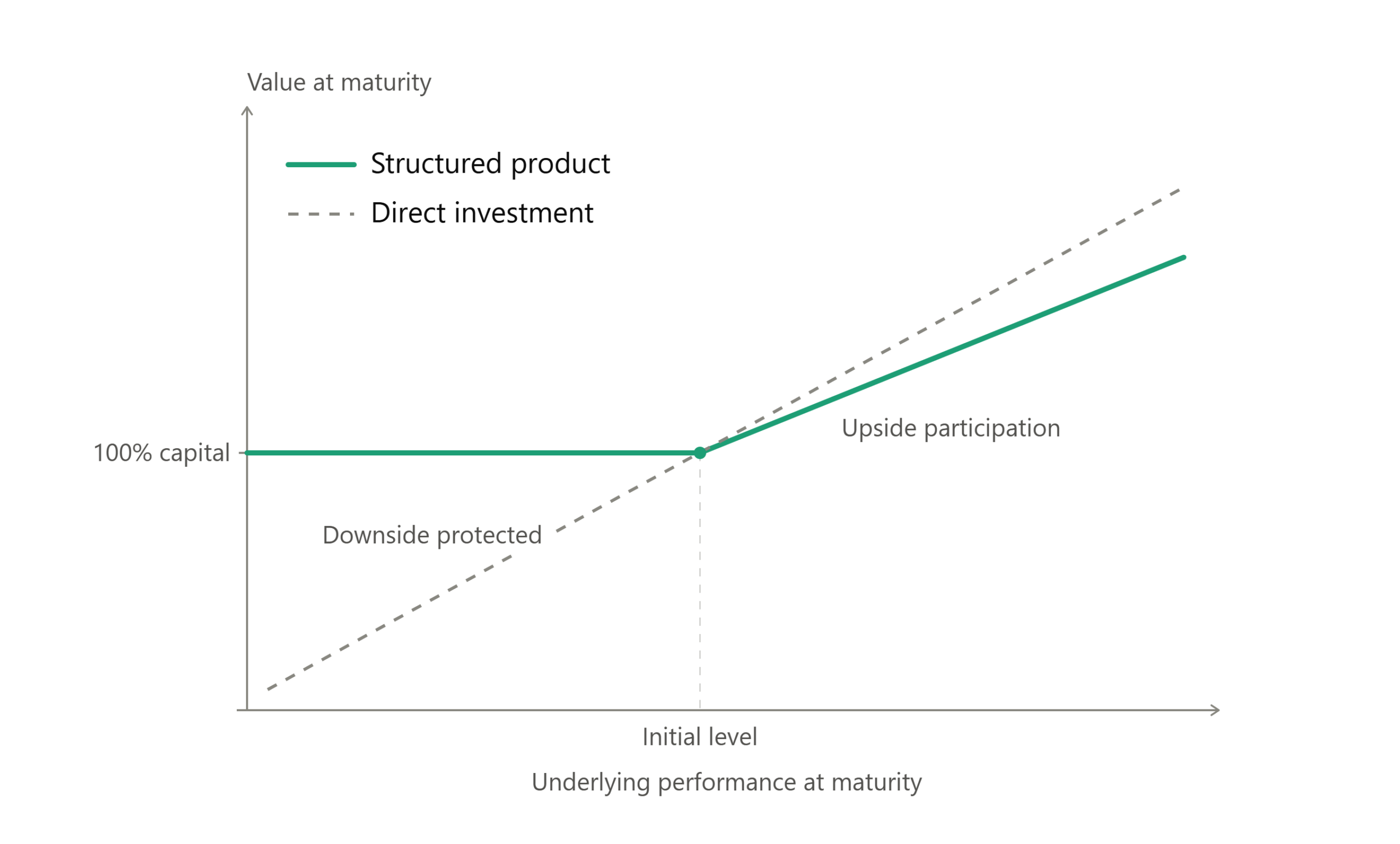
Figure 1 represents what happens between issue and maturity date.
Although the pricing mechanisms that drive these values are complex, the underlying principle is fairly simple. On the issue date you pay the face amount of $1,000. This note is structured for 100% capital protection, meaning it is designed to return your $1,000 at maturity regardless of how the underlying asset performs, provided the issuer meets its obligations. This is accomplished via the zero-coupon bond accreting from its original issue discount to face value.
For the performance component, the underlying asset is priced as a European autocall option, and will have intrinsic value at maturity if its value on that date is higher than its value when issued. If applicable, you earn that return on a one-for-one basis. If not, the option expires worthless and you get nothing in excess of your $1,000 return of capital.
Custom Sizing
100% capital protection offers a key benefit in the above example but an investor may be willing to trade off some or all protection in favour of more attractive performance potential. Let’s look at another example in which the investor gives up 100% capital protection for a combination of more potent performance features.
If the return on the underlying asset (R asset) is positive – between zero and 7.5% – the investor will earn double the return (e.g. 15% if the asset returns 7.5%). If R asset is greater than 7.5%, the investor’s return will be capped at 15%. If the asset’s return is negative, the investor participates one-for-one on the downside (i.e. no negative leverage). There is no capital protection.
Figure 2 shows the payoff curve for this scenario.
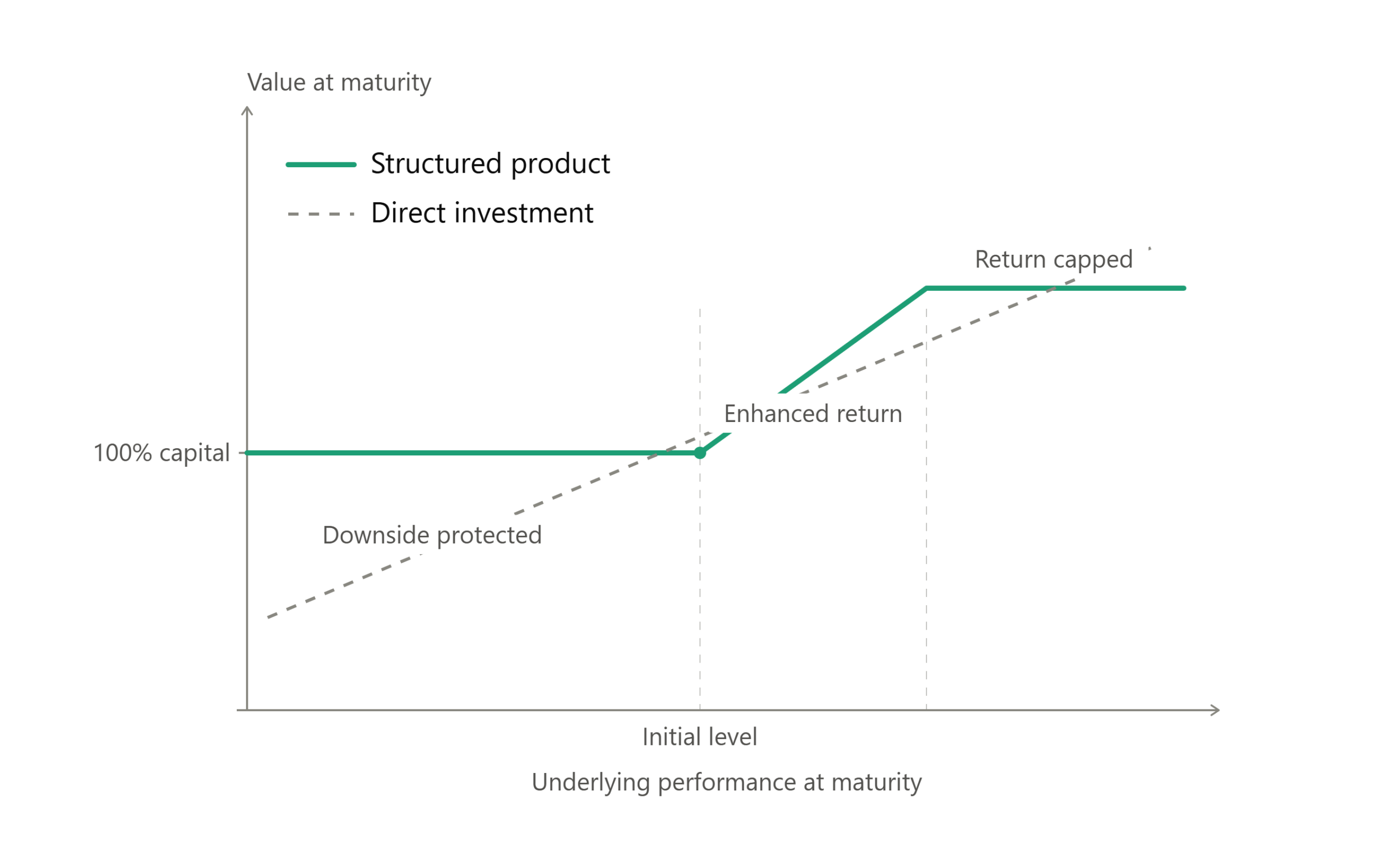
This strategy would be consistent with the view of a mildly bullish investor – one who expects positive but generally weak performance and is looking for an enhanced return above what he or she thinks the market will produce.
The Rainbow Note
One of the many attractions of structured products for retail investors is the ability to customize a variety of assumptions into one instrument. For example, a rainbow note is a structured product that offers exposure to more than one underlying asset. A lookback is another popular feature. In a lookback instrument, the value of the underlying asset is based not on its final value at expiration, but on an average of values taken over the note’s term, for example monthly or quarterly. In the options world, this is also called an Asian option to distinguish the instrument from the European or American option. Combining these types of features can provide attractive diversification properties.
A rainbow note could derive performance value from three relatively low-correlated assets, like the Russell 3000 Index of U.S. stocks, the MSCI Pacific ex-Japan index and the Dow-AIG commodity futures index. Attaching a lookback feature to this structured product could further lower volatility by “smoothing” returns over time.
How structured products are built
At heart, each product combines two parts. Most of your money sits in a bond or deposit that works to return your capital over the term, and a smaller part buys a derivative, usually an option, that provides the market exposure. That pairing is what lets these products offer a defined outcome.
The main types of structured product
Most structured products fall into one of a few familiar shapes.
- Capital protected. Aim to return all, or a set percentage, of your original capital at maturity, while still giving some market exposure. See our guide to capital protected investments.
- Income or coupon. Pay a regular coupon, either fixed or conditional on the underlying market holding above an agreed level.
- Participation or growth. Give a share of any rise in the underlying market, sometimes at an enhanced rate, rather than a fixed coupon.
- Autocall. Can mature early on set dates if the market meets a defined condition. Our guide explains how an autocall works.
Structured products explained: the pros and cons
Like any investment, structured products involve trade offs.
Advantages
- A defined, known outcome set at the outset.
- The option of a defined level of capital protection.
- Access to markets and payoff shapes that are hard to build otherwise.
- The ability to earn a return in flat or modestly rising markets.
Disadvantages
- Issuer credit risk. A structured product is an unsecured debt security, so if the issuing bank fails you could lose money even when the underlying market performed well. This is the most important risk to understand.
- Capped upside. Many structures limit how much you can make, so you may not capture the full rise of a strong market.
- Limited liquidity. They are built to be held to maturity, so selling early can mean an uncertain price.
- Complexity. The terms reward careful reading, where an Adviser adds value.
Who structured products suit
Structured products tend to suit investors who have a clear view on a market over a set term, who value a defined outcome, and who are comfortable holding to maturity. Advisers and Wealth Managers often use them to shape a specific risk and return profile within a portfolio. They suit less well anyone needing instant access to their money, or wanting uncapped exposure to a rising market.
The Bottom Line
The complexity of derivative securities has long kept them out of meaningful representation in traditional retail and many institutional investment portfolios. Structured products can bring many derivative benefits to investors who otherwise would not have access to them. As a complement to traditional investment vehicles, structured products have a useful role to play in modern portfolio management.
To find out how you can invest in NEBA’s Structured Products, visit www.nebafinancialsolutions.com
Source: Investopedia
