Debasement 2.0?
Market action this past week was defined by one dominant force: the bond market flexing its muscles and forcing Washington to respond. As US Treasury yields climbed toward two-decade highs, with federal debt crossing a record $40 trillion, the Treasury announced it would at least double its long-dated bond buybacks, from $2 billion to $4 billion per operation.
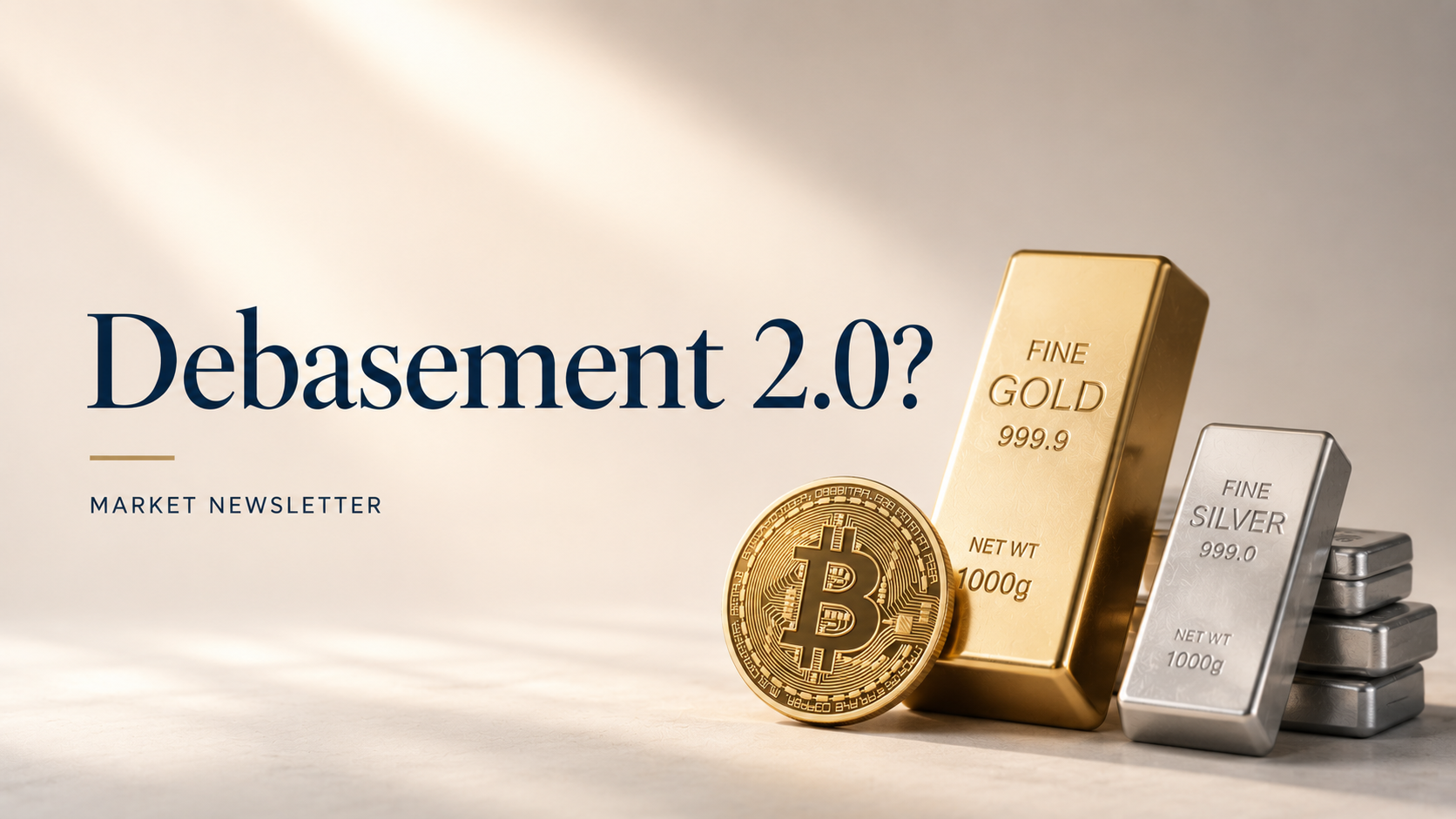
The move was designed to contain surging long-term borrowing costs, but its knock-on effect has been profound. Echoes of 2025 are resurfacing as “debasement trade 2.0” takes hold, with investors questioning the value of holding dollars and government paper, and pivoting toward assets seen as genuine stores of value — most notably gold, and its digital counterpart, Bitcoin.
Equities Retreat Despite a Booming Economy
US equities retreated against this backdrop. The S&P 500 fell 1.4%, while the technology-heavy Nasdaq shed almost 2.5%. Notably, the weakness came despite strong economic data: the S&P Global flash composite Purchasing Managers’ Index jumped to 56 in August, the fastest pace of business growth since April 2022, while the services index hit a 20-month high. The economy is booming, yet the market’s attention is focused squarely on the cost of money and the treacherous path of government borrowing.
Beneath the headline indices, corporate news provided some remarkable individual stories. Moderna surged 177% in a single day and 130% over the week, after positive late-stage trial results for its personalised mRNA melanoma vaccine, developed with Merck — the first successful Phase 3 readout for any mRNA cancer therapy, validating a technology that has struggled since the pandemic.
Closer to home, markets were more resilient. The FTSE 100 gained 0.6%, helped by commodity-related stocks, while European equities recovered on Friday despite finishing a volatile week under pressure. Economic data also offered encouragement, with eurozone business activity expanding at its fastest pace since November and manufacturing showing signs of improvement.
Looking east, the Hang Seng was the standout performer, rising over 3.5% as Chinese equities attracted fresh inflows and regional sentiment improved. Conversely, Japan’s Nikkei fell 3.9%, as Japanese assets remained sensitive to the prospect of further Bank of Japan policy normalisation, which could bring higher interest rates and fresh currency support.
Hard Assets Take the Spotlight
The real action, though, was in hard assets. Gold surged more than 5% to above $4,600 an ounce, illustrating the yellow metal’s unusual ability to benefit from several competing concerns at once: geopolitical uncertainty, inflation, falling confidence in government debt, and doubts over the long-term value of paper currencies. Silver also rallied strongly, moving toward $70, benefiting from both its monetary and industrial demand drivers.
Oil rallied too, as stalled progress over Iran kept supply risks firmly in focus. Brent crude gained 6.6% over the week, while WTI advanced 5.7%, adding another complication for policymakers worldwide attempting to tame inflation.
Bitcoin was another major beneficiary of the week’s debasement trade, surging more than 23% in its strongest weekly performance in roughly two and a half years. The move was reinforced by the return of institutional demand for “digital gold,” with US spot Bitcoin ETFs attracting more than $1.6 billion between Monday and Thursday alone. Washington added a further tailwind, with President Trump urging Congress to advance the Clarity Act, which aims to provide legal guidelines on whether digital assets fall under securities or commodities rules.
What to Watch This Week
Attention now turns to what could be another pivotal week for policymakers. After the bond market’s warning shots, Federal Reserve Chair Kevin Warsh’s first speech at Jackson Hole will carry considerable weight. Earnings from AI and technology heavyweights — Nvidia and CrowdStrike on Wednesday, followed by Marvell Technologies on Thursday — will provide an important test of confidence in the AI investment cycle. Nvidia in particular has become far more than an individual earnings report; its results increasingly act as a temperature gauge for the entire AI narrative.

Debasement Trade Takes Hold — August has produced a striking divergence across asset classes. While the S&P 500 has made little progress and the US Dollar Index has weakened, Gold and Bitcoin have risen sharply, with the move accelerating through the past week. The catalyst has been growing scrutiny of US borrowing and the bond market, culminating in the Treasury’s decision to increase long-dated bond buybacks. Investors’ response has been to favour assets perceived as scarce stores of value — gold remains the traditional expression of that view, while Bitcoin is increasingly participating alongside it.
At NEBA Financial Solutions, we see this week’s developments as a timely reminder of why diversification across asset classes, geographies and currencies remains central to sound long-term financial planning, particularly for internationally mobile clients managing wealth across multiple jurisdictions and currency exposures. As always, we encourage clients to speak with their wealth manager before making any changes to their portfolio in response to short-term market moves.
This article is based on insights and analysis provided by Matthew Boxall of TEAM.
