

Is the Semiconductor Rally Losing Momentum?
For much of the past year, semiconductor stocks have been among the strongest performers in global markets, driven by enthusiasm surrounding artificial intelligence, cloud computing, and data centre expansion.
However, last week’s sharp sell-off across major chipmakers suggests investors may be reassessing valuations and rotating capital into other sectors.
The question now is whether this represents a temporary pause or the beginning of a broader shift in market leadership.
Semiconductor Stocks Come Under Pressure
The first signs of weakness emerged when Broadcom shares fell sharply despite reporting strong earnings results. The decline quickly spread across the semiconductor sector, with companies such as Nvidia, Micron and Intel also experiencing notable weakness.
The pressure intensified after major Asian semiconductor names, including Samsung Electronics and SK Hynix, declined significantly, contributing to a sharp fall in South Korea’s KOSPI Index. Taiwan Semiconductor Manufacturing Company also participated in the broader retreat.
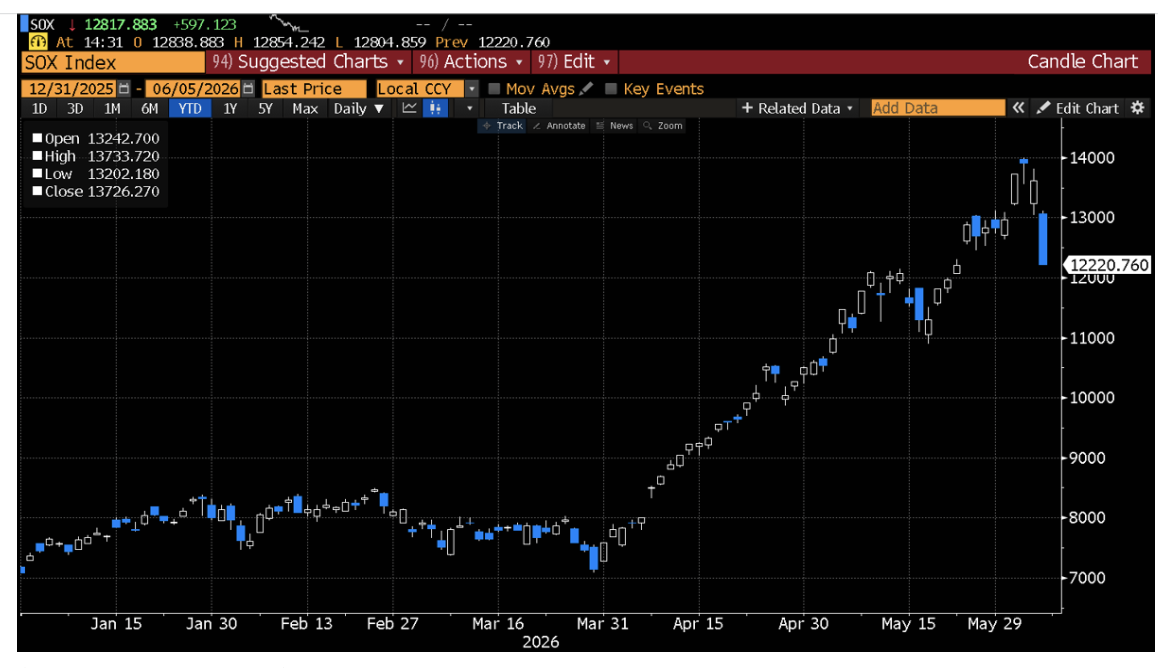 Philadelphia Semiconductor Index (SOX) showing the recent correction following an extended rally. Source: Bloomberg.
Stronger Economic Data Changes the Narrative
Investor sentiment shifted further following the release of US nonfarm payroll data.
The report showed that 172,000 jobs were added during May, significantly above market expectations. Revisions to previous months also revealed stronger employment growth than previously estimated.
As a result, expectations for US interest rates have changed dramatically. Markets are now pricing in a higher probability that the Federal Reserve may need to keep monetary policy tighter for longer.
Higher interest rates tend to place pressure on high-growth sectors, particularly companies whose valuations depend heavily on future earnings growth.
Rising Yields and Valuation Pressure
Treasury yields moved higher as investors adjusted their expectations for future monetary policy.
For semiconductor companies, which have benefited from exceptionally strong investor optimism over recent years, higher discount rates create additional valuation pressure.
This does not necessarily imply a deterioration in business fundamentals. Instead, it reflects a reassessment of how much investors are willing to pay for future growth.
A Healthier Market Rotation?
While the recent sell-off may appear concerning, there is another way to interpret recent market action.
For much of the current bull market, performance has been concentrated among a relatively small group of technology and AI-related companies. A broadening of market leadership could potentially create a more balanced and resilient investment environment.
If capital begins flowing into sectors beyond semiconductors and artificial intelligence, markets may become less dependent on a handful of high-profile names.
Looking Ahead
The semiconductor sector remains central to long-term themes such as artificial intelligence, automation and digital infrastructure.
However, recent market movements serve as a reminder that even the strongest trends experience periods of consolidation.
Investors will continue watching economic data, interest-rate expectations and earnings developments closely to determine whether the current weakness represents a temporary correction or the start of a more sustained rotation within global equity markets.
This article is based on insights and analysis provided by David Gorman of TEAM Asset Management.
