Risk Reassessed: Hormuz Reopens as Warsh Signals a Tougher Fed
Global markets were handed no shortage of drama last week, yet ultimately chose optimism over alarm. A record-breaking IPO, a hawkish Federal Reserve debut, a divided Bank of England, and arguably the most consequential geopolitical development since February all collided within a single trading week.
That Changes Things
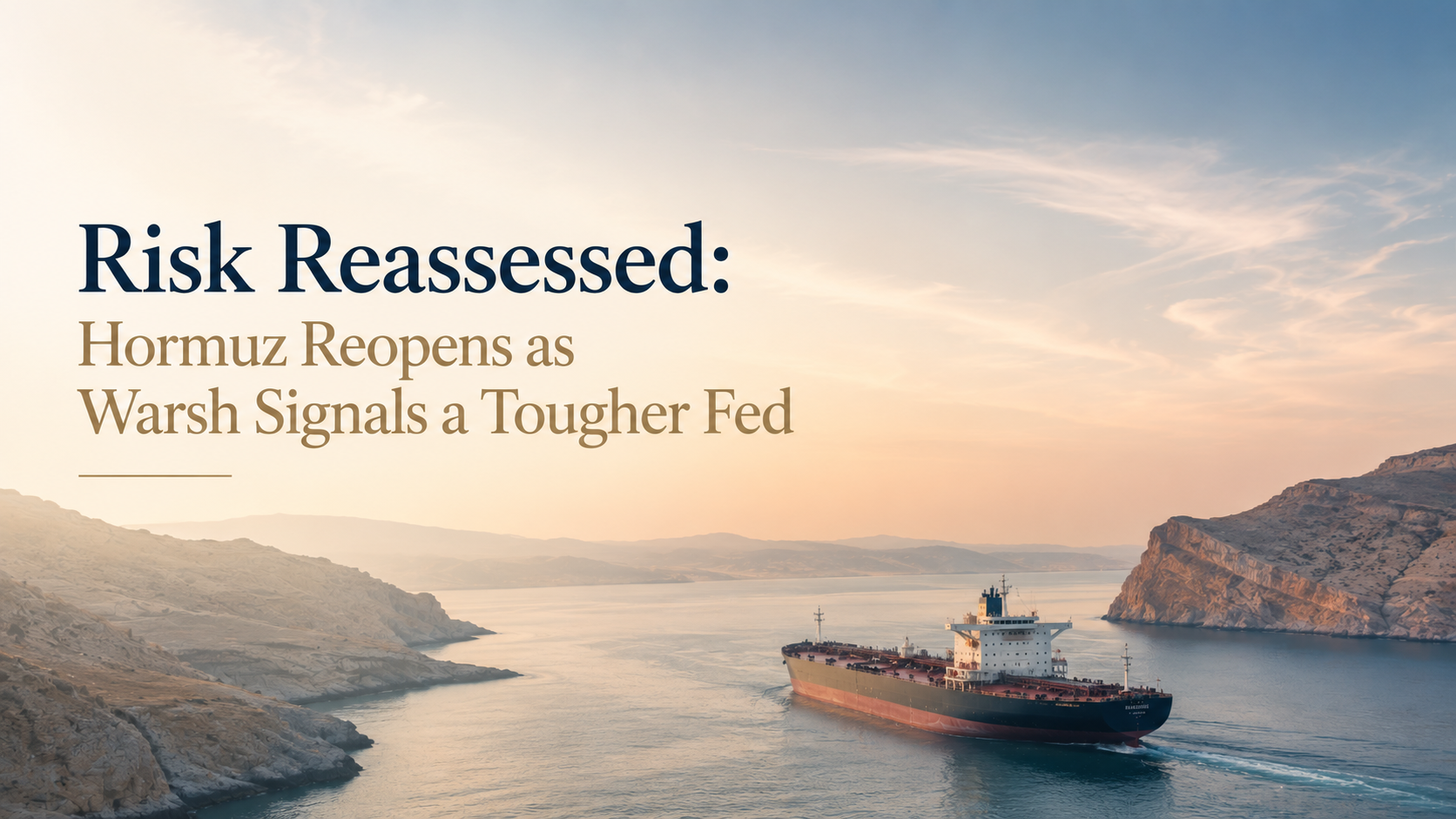
The defining macro development arrived, once again, from the Gulf. The United States and Iran advanced an interim peace framework, setting in motion the reopening of the Strait of Hormuz, a route critical to global oil flows. Markets responded immediately, putting a bid under import-dependent economies including Japan. Brent crude fell sharply into the high $70s, retracing much of the earlier conflict-driven spike and prompting a reassessment of how far the spring energy shock will continue to feed through to inflation.
A Hawkish Debut for the New Fed Chair
That shift matters for prices at the pump in the short term, but markets were quickly reminded of the delicate balancing act facing central bankers, as Kevin Warsh chaired his first FOMC meeting as Federal Reserve Chair. Rates were held at 3.50%-3.75%, but the tone was unmistakably hawkish: the policy statement was sharply cut, forward guidance was removed, and projections shifted from implying cuts to signalling that hikes remain firmly on the table.
The message was unambiguous. Unlike his predecessor Jerome Powell, the Warsh Fed is prioritising inflation credibility, even at the expense of near-term market comfort. Following the statement and press conference, investors sharply increased their expectations for additional rate hikes, with interest-rate futures moving to price in roughly 1.5 quarter-point hikes by year-end, about double the expectation heading into the meeting.
Central Banks Move in Lockstep
It was a busy period for monetary policy more broadly. The Bank of Japan raised rates to 1.00%, its highest level in three decades, pressing ahead with policy normalisation. Closer to home, the Bank of England held at 3.75%, but with a widening 7-2 split as two members backed a hike. The common thread across these decisions is clear: the bar for easing is rising, not falling.
In the UK, the policy backdrop is being complicated further by ongoing political uncertainty, with pressure on the government intensifying following a high-profile by-election result.
Diverging Interpretations Across Asset Classes
What stands out most is how differently markets are interpreting the same set of facts. Bond markets are signalling discipline, caution and the spectre of inflation risks ahead. The move higher in shorter-term yields reflected not just the rate decision itself, but a shift in how the Fed intends to operate. Gone is the language of reassurance; in its place is brevity, ambiguity, and a renewed emphasis on inflation credibility.
Equities, by contrast, remain focused on growth, liquidity and the enduring pull of the AI theme. SpaceX sits squarely at the centre of that tension. Its Nasdaq debut, the largest IPO in history, prompted a wave of ETF, index and retail investor flows, sending its valuation surging. The story highlights how flows, rather than fundamentals alone, are an increasingly important factor driving index returns.
Price action in commodities told the cleanest story of the week. The prospect of restored flows through the Strait of Hormuz represents a meaningful reversal of the supply shock that has defined much of the year. Gold moved in the opposite direction, falling on the back of a stronger dollar and higher real yields, a reminder that even safe havens must contend with the opportunity cost of rising rates. Industrial metals were more mixed, balancing improved growth sentiment against currency headwinds.
Looking Ahead
In summary, five forces defined the week. SpaceX reignited the debate over valuation and the power of passive flows. Warsh signalled a sharper, more hawkish Fed. The Bank of Japan tightened further, while the Bank of England held under growing internal pressure to move. Political uncertainty added a UK-specific layer of complexity. And, above all, the US-Iran agreement, however fragile, removed the single largest macro headwind weighing on inflation and sentiment since February.
Whether equity market optimism proves durable will depend on two factors: first, whether the reopening of the Strait of Hormuz holds, and second, whether central banks look through falling energy prices and maintain their tightening bias. For now, investors have chosen to believe the best news on offer. Summer markets, as ever, may yet have other ideas.
At NEBA Financial Solutions, we continue to monitor developments across global markets and assess how changing economic conditions may impact investment opportunities. Maintaining diversification and a disciplined long-term approach remains central to navigating evolving market environments.
📩 Get in touch: info@nebafinancialsolutions.com
This article is based on insights and analysis provided by Francesca Le Feuvre of TEAM.
