
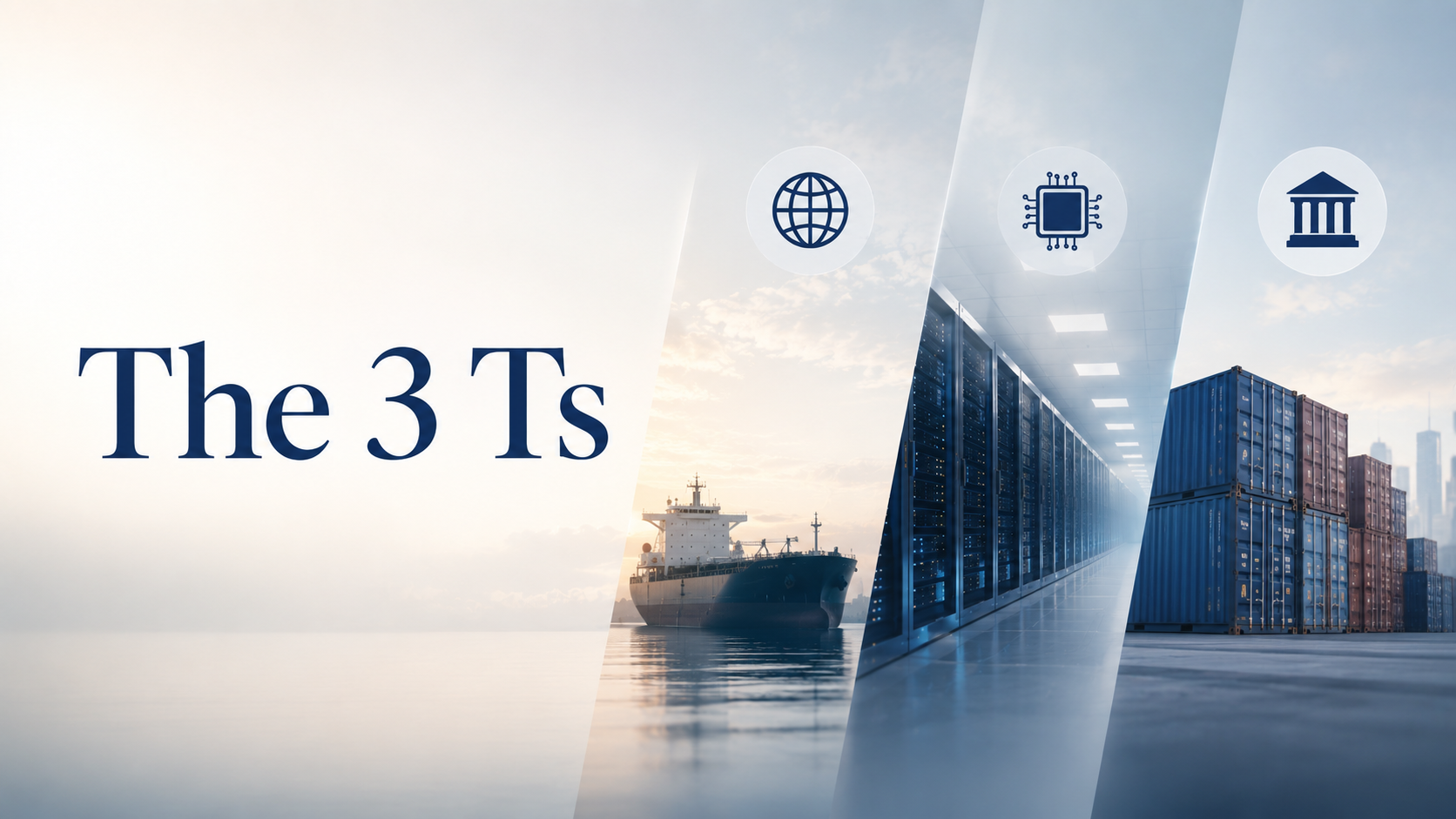
The 3 Ts: Tehran, Technology and Tariffs Keep Investors on Edge
Global equity markets drifted lower over the past month as three familiar forces reasserted themselves: geopolitical tension centred on Iran, an extraordinary build-out in artificial intelligence infrastructure, and the return of tariff politics in Washington. For internationally mobile clients holding diversified portfolios, understanding how these threads interact matters more than tracking any single headline.
An Uneasy Truce in the Gulf
The ceasefire agreed between the United States and Iran only weeks earlier has, for now, been overtaken by events. Renewed military action in Iranian territory, targeted at maritime capability, air defence, and communications infrastructure, prompted retaliatory strikes by Iran’s Revolutionary Guards against commercial tankers moving through the Strait of Hormuz, along with attacks on Gulf infrastructure hosting American forces.
The practical consequence for investors has been felt most directly in the oil market. Shipping volumes through the Strait, a corridor that carries a significant share of the world’s seaborne oil trade, have become far less predictable, and crude prices finished the period roughly seven percent higher. That move carries weight beyond the energy sector alone: a sustained rise in oil prices tends to feed into inflation expectations, which in turn shapes how central banks, and particularly the US Federal Reserve, think about the timing of interest rate decisions.
The AI Build-Out and an Early Warning from Credit Markets
Away from the Gulf, corporate earnings season has told a more encouraging story on the surface. Guidance from S&P 500 companies has come in ahead of analyst expectations by the widest margin on record, and executive sentiment on business conditions remains upbeat.
Underneath that optimism, however, sits a striking commitment of capital to artificial intelligence infrastructure. Alphabet has signalled capital expenditure of between $195 billion and $205 billion in 2026 to keep pace with chip and data centre demand, a level of spending that would turn the company free cash flow negative for the first time in its history as a listed business. Tesla, meanwhile, raised its own capex guidance by 142 percent year on year even as price cuts weighed on margins.

It is in the credit derivatives market that the more interesting signal has emerged. Credit default swaps, in essence the cost of insuring against a borrower defaulting on its debt, widened sharply this period across the most heavily leveraged AI-related businesses. More notably, that widening has begun to spread to hyperscale technology companies that have long been regarded as close to unassailable. When the market’s pricing of default risk moves on names previously considered untouchable, it is worth watching closely, regardless of how strong current earnings appear.
Tariffs Return to the Table
Completing the picture, Washington has revived its tariff agenda, with new duties of between 10 and 12.5 percent announced against more than sixty trading partners, including the European Union, United Kingdom, China, and Canada, framed around forced-labour concerns. Separate measures targeting select Canadian goods, at rates as high as 50 percent, have added further friction to an already complex trade backdrop.
What This Means for Portfolio Positioning
None of these three forces is new in isolation, but their combination, geopolitical risk in energy markets, concentrated and capital-intensive technology growth, and renewed trade friction, reinforces the case for diversification across asset classes, currencies, and geographies rather than concentration in any single theme. Summer months typically bring thinner trading volumes, which can amplify price moves in either direction, making disciplined, long-term positioning more valuable than short-term reaction.
At NEBA Financial Solutions we help clients build resilient, globally diversified portfolios designed to weather periods of geopolitical and market uncertainty, while keeping sight of long-term financial goals.
This article is based on insights and analysis provided by Craig Farley of TEAM Asset Management .
