
Global bond markets remained at the centre of investor attention last week, as 30-year US Treasury yields pushed through to a 19-year high.
At first glance, this may not seem especially extreme from a long-term historical perspective. However, markets rarely react only to the level of yields. They react to the speed of the move.
And the speed of the latest move higher has been enough to unsettle investors.
Why Bond Yields Matter for Investors
Bond yields are, in effect, the price of money.
When the price of money rises sharply, the impact does not remain limited to the fixed income market. It flows through to borrowing costs for businesses and consumers, affects financial conditions across the economy, and influences the valuations that underpin equity markets.
For investors, this matters because higher yields can make it harder to justify expensive equity valuations, particularly in areas of the market where expectations are already high.
The Federal Reserve Faces a Difficult Balancing Act
Against this backdrop, the Federal Reserve finds itself in an increasingly uncomfortable position.
Minutes from the latest FOMC meeting suggested that some policymakers may be willing to move away from an easing bias. There was also acknowledgement that interest rates may still need to rise before they can fall.
This matters because many investors had previously expected the next major move from the Fed to be a rate cut.
If that assumption becomes less certain, both bond and equity markets may need to adjust their expectations.
The Growing Disconnect Between Bonds and Equities
One of the most important developments in the market right now is the growing disconnect between bonds and equities.
Bond markets appear to be signalling tighter financial conditions, higher discount rates, and greater fragility in the system.
Equity markets, by contrast, have continued to move higher, seemingly unfazed by those warnings.
This divergence would be notable at any point in the cycle. But it becomes even more important when valuation is considered.
The cyclically adjusted P/E ratio for US equities is now approaching levels last seen during the peak of the dot-com bubble.
That does not necessarily mean a correction is imminent. However, it does suggest that expectations are already very demanding.
A Shift from Capital Discipline to Capital Investment
Another important shift is taking place in investor behaviour.
For much of the past decade, markets rewarded companies that demonstrated capital discipline. Investors favoured businesses that returned capital through dividends, buybacks, and improved operational efficiency.
Today, the market appears increasingly willing to reward capital investment, even when that investment comes at the expense of near-term cash flow.
The AI boom is leading this change in sentiment.
Large-scale capital expenditure in data centres, semiconductor infrastructure, and AI-related technology is now being viewed less as a risk and more as a necessity.
For private clients, this is an important distinction. What may look positive for equity holders is not always positive for bondholders. A company investing heavily in future growth may excite equity investors, but it can also raise questions around cash flow, leverage, and balance sheet discipline.
Nvidia Shows How High Expectations Have Become
That tension was clearly visible in Nvidia’s latest results.
The company delivered exceptionally strong numbers, including around 85% sales growth and operating margins of more than 60%.
Despite this, its share price fell modestly.
The issue was not weak performance. The issue was expectations.
For companies seen as central to the AI build-out, investors have already priced in a very high level of future success. This means that even strong results may not be enough when expectations are already stretched.
Nvidia’s reaction highlights how demanding the market has become for AI-linked companies.
Semiconductor Stocks Remain at the Centre of the Rally
Semiconductor companies continue to sit at the centre of the rally, helping push both the sector and the wider S&P 500 to fresh highs.
The rise of companies such as Micron and SK Hynix toward trillion-dollar valuations highlights how concentrated this leadership has become.
If AI delivers on its promise, these valuations may eventually prove justified.
But that “if” remains important.
Chart of the Week: The New Trillionaires
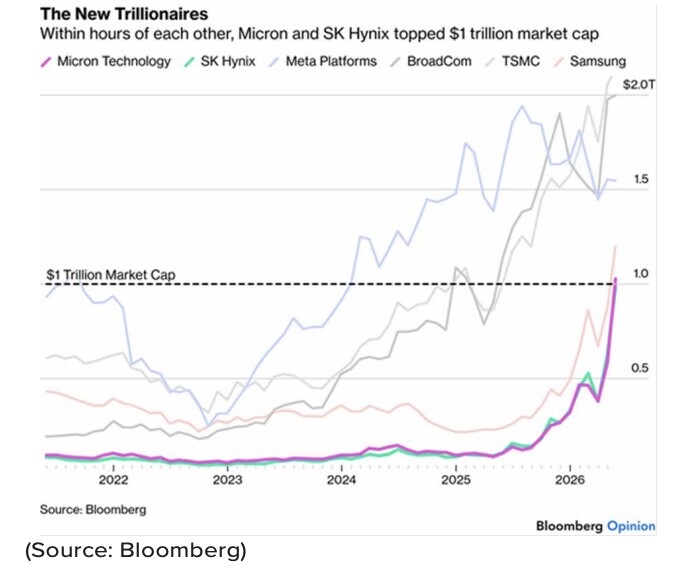
Micron and SK Hynix have joined the group of stocks reaching a $1 trillion market capitalisation, reflecting the strength of investor demand for companies positioned within the AI hardware supply chain.
This chart underlines how much of the current equity rally is being driven by a relatively small group of AI-linked semiconductor winners.
It also raises an important question for investors: how much of today’s market optimism depends on AI continuing to deliver at an extraordinary pace?
Geopolitics Remains a Background Risk
While AI and interest rates continue to dominate market attention, geopolitics remains an important risk in the background.
The lack of resolution around the Strait of Hormuz continues to hang over markets.
So far, commodity prices have not fully reflected this risk. However, the situation remains fragile. Any meaningful escalation could quickly affect energy markets and, by extension, inflation expectations.
This is particularly important at a time when bond markets are already sensitive to inflation and interest rate expectations.
What This Means for Private Clients
For now, equity markets appear willing to look through these risks and continue leaning into the optimism surrounding AI-led growth.
Bond markets, however, are sending a more cautious message.
For investors, the key takeaway is not to avoid equities altogether, but to remain selective, disciplined, and aware of where expectations may already be stretched.
In an environment where bond markets are signalling caution while equities continue to price in optimism, portfolio balance becomes increasingly important.
Final Thought
The question is not whether AI can continue to transform markets.
The question is whether current valuations already assume too much of that transformation too quickly.
When bonds speak, equities do not always listen immediately.
But investors should.
At NEBA Private Clients, we help clients make sense of changing markets and build portfolios with clarity, discipline, and long-term purpose.
This article is based on insights and analysis provided by the TEAM Asset Management.
This article first appeared in the NEBA Weekly Update newsletter on LinkedIn.
